The quiet survival mechanism EMS rarely talks about
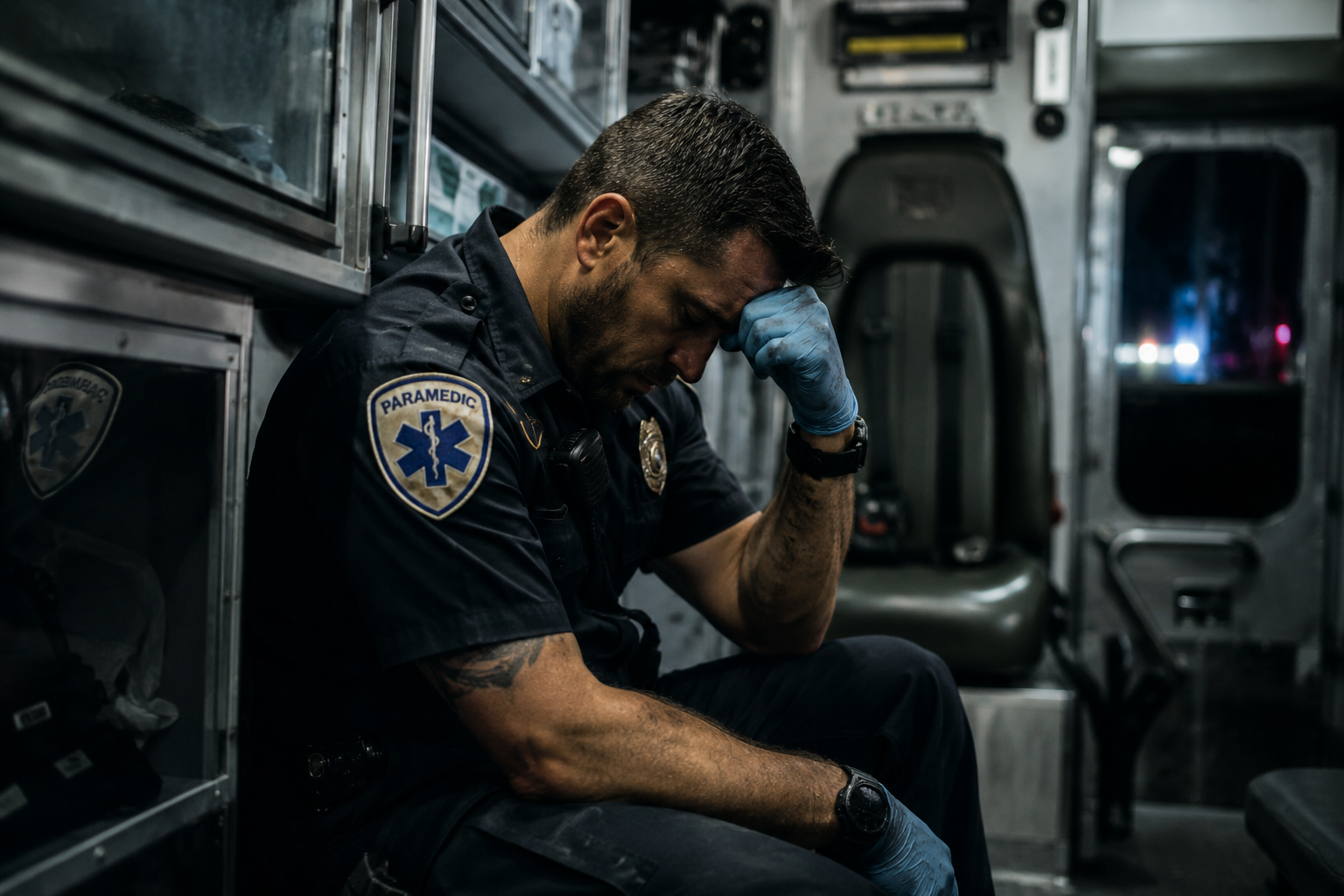
There is a point in EMS where experience can start to look like coldness.
Not because the provider does not care.
But because caring has become expensive.
At first, every call gets in.
The crying family.
The child who looks like your own.
The elderly patient apologizing for “being a burden.”
The overdose patient everyone else has already judged.
The cardiac arrest where the room knows the outcome before anyone says it out loud.
Early in a career, providers often absorb everything emotionally. They replay calls in their heads while driving home. They carry faces with them for days. They question themselves constantly. They feel the adrenaline, the sadness, the frustration, the fear.
Then years pass.
The voice becomes flatter.
The reactions become smaller.
The provider becomes efficient, calm, controlled.
And somewhere in the middle of all that professionalism… something can quietly shift.
Patients slowly become tasks.
Not intentionally.
But functionally.
The diabetic emergency becomes “another hypoglycemic.”
The intoxicated patient becomes “another drunk.”
The elderly fall becomes “another lift assist.”
The screaming family becomes “difficult relatives.”
And that is where emotional detachment begins to quietly hide inside experience.
Not incompetence.
Not cruelty.
Protection.
The problem is that protection can slowly become disconnection.
Burnout is often misunderstood as simply being tired. In reality, one of its defining characteristics is emotional distancing and depersonalization, where providers unconsciously begin separating themselves emotionally from patients and from the meaning of their work [1].
In EMS, emotional detachment rarely arrives dramatically.
It arrives quietly.
It sounds like sarcasm becoming constant.
It sounds like cynicism replacing empathy.
It looks like a provider who no longer reacts to tragedy the way they once did.
And sometimes the scariest part is this:
The detached provider is often still clinically excellent.
They still know the medicine.
They still perform under pressure.
They still manage scenes effectively.
But internally, the emotional connection to the human being in front of them starts fading.
That is why this issue is so dangerous.
Because emotional detachment can hide behind competence for years.
Research involving EMS professionals has consistently shown high levels of emotional exhaustion, depersonalization, and compassion fatigue among prehospital providers [2][3]. Repeated exposure to trauma, suffering, death, violence, and chronic system stress creates cumulative psychological wear that many providers never fully process.
And EMS is uniquely vulnerable to this.
Unlike many professions, EMS does not allow emotional decompression between difficult events.
One moment you are informing a family their loved one has died.
Ten minutes later you are dispatched to chest pain.
Then a psychiatric emergency.
Then a pediatric fever.
Then a violent trauma.
Then back to station as though nothing happened.
Human beings were never designed to emotionally process suffering at this speed indefinitely.
So the mind adapts.
It creates distance.
Distance allows providers to continue functioning in chaos.
Without some degree of emotional compartmentalization, many providers would collapse under the weight of repeated trauma exposure. The problem occurs when compartmentalization stops being temporary and becomes permanent.
Because there is a difference between:
“I need emotional control right now”
and
“I no longer feel connected to this work at all.”
One is resilience.
The other is emotional withdrawal.
And emotional withdrawal often masquerades as maturity.
Senior providers are sometimes praised for “never getting emotional.”
But emotional absence is not always strength.
Sometimes it is exhaustion that has calcified.
This is where we begin seeing changes in behavior and culture within healthcare environments.
Dark humor becomes more aggressive.
Patients become labels instead of people.
Younger staff who still show emotion are mocked for “not being hardened enough.”
Compassion becomes viewed as weakness rather than professionalism.
Eventually, providers stop discussing what they feel entirely.
Not because they are coping well.
Because they have normalized not coping at all.
Compassion fatigue is now increasingly recognized as a significant issue across healthcare and emergency response professions. It is often described as the emotional cost of prolonged exposure to other people’s suffering [3]. Over time, providers can begin emotionally numbing themselves not only to protect against pain… but simply to survive the volume of it.
And sometimes the damage does not come from trauma itself.
Sometimes it comes from helplessness.
This is where moral injury enters the conversation.
Moral injury occurs when providers repeatedly find themselves unable to deliver the level of care they believe patients deserve due to systemic limitations, operational pressures, staffing shortages, delays, overcrowding, or institutional constraints [4][5].
The provider knows what should happen.
But the system prevents it.
The ambulance waits outside overcrowded emergency departments for hours.
Patients cannot access follow-up care.
Crews are pushed into mandatory overtime.
Staffing shortages force dangerous workloads.
Providers are expected to function perfectly inside increasingly imperfect systems.
Eventually, many stop emotionally investing because emotionally investing starts hurting too much.
The disappointment becomes chronic.
Then cynicism develops.
Then numbness follows.
And numbness feels safer than caring.
This is why emotional detachment is often seen most heavily in:
- High-volume urban EMS systems
- Emergency departments
- Intensive care units
- Flight and critical care transport teams
- Systems with chronic staffing shortages
- Organizations with poor leadership support
- Environments where providers feel replaceable rather than valued
The emotional burden of repeated exposure to human suffering is compounded further by long shifts, disrupted sleep cycles, circadian fatigue, operational stress, and the pressure of constant hypervigilance [6].
And yet many providers never speak about it openly.
Because healthcare often rewards emotional suppression.
We praise people for “holding it together.”
We rarely ask what it cost them to do so.
So how do we avoid emotional detachment without becoming emotionally overwhelmed?
Not through motivational posters.
Not through empty wellness campaigns.
And not by simply telling providers to “care more.”
People who become emotionally detached often cared deeply before they became detached.
The answer is not guilt.
The answer is awareness.
The first step is recognizing that emotional detachment is not always obvious. It often develops gradually over years.
Providers need to monitor themselves honestly.
Has cynicism become your default language?
Do you still see patients as people?
Do you still feel empathy… or only obligation?
Have you stopped talking about difficult calls entirely?
Do you feel emotionally absent even outside work?
Organizations also carry responsibility here.
Leadership matters enormously.
Supportive leadership, healthy staffing models, psychological safety, peer support systems, reasonable workloads, recovery time, and emotionally intelligent supervisors all play major roles in reducing burnout and depersonalization [2][5].
But individual habits matter too.
Small things matter.
Use the patient’s name.
Explain procedures even if the patient appears unconscious.
Speak respectfully about patients after calls.
Protect your sleep.
Maintain relationships outside healthcare.
Allow yourself to acknowledge when something affected you emotionally.
Do not confuse emotional suppression with professionalism.
And perhaps most importantly:
Pay attention when dark humor stops being occasional coping and starts becoming your personality.
Experience should absolutely change us.
It should make us calmer under pressure.
It should make us clinically sharper.
It should improve judgment, pattern recognition, scene management, and emotional regulation.
But it should not make us unreachable.
Because the danger is not that experienced providers stop knowing what to do.
The danger is that they slowly stop remembering why it matters.
And maybe the real mark of an experienced EMS professional is not the ability to witness suffering without emotion.
Maybe it is the ability to remain functional without becoming numb.
To stay compassionate without collapsing.
To protect yourself psychologically without losing your humanity in the process.
Because the moment patients become objects instead of people… healthcare quietly loses something it cannot afford to lose.
References
[1] World Health Organization. Burn-out an occupational phenomenon: International Classification of Diseases. Referenced in discussion regarding burnout, depersonalization, and emotional distancing in healthcare workers.
[2] Sterud T, Ekeberg Ø, Hem E. Health status in the ambulance services: A systematic review. Referenced in sections discussing emotional exhaustion, depersonalization, and occupational stress among EMS professionals.
[3] Figley CR. Compassion Fatigue: Coping With Secondary Traumatic Stress Disorder in Those Who Treat the Traumatized. Referenced in discussion regarding compassion fatigue and cumulative emotional exposure.
[4] Dean W, Talbot S, Dean A. Reframing clinician distress: Moral injury not burnout. Referenced in sections discussing moral injury and systemic barriers preventing providers from delivering ideal care.
[5] Williamson V, Murphy D, Greenberg N. COVID-19 and experiences of moral injury in frontline key workers. Referenced in discussion regarding psychological injury, helplessness, and emotional withdrawal caused by healthcare system pressures.
[6] U.S. Bureau of Labor Statistics. EMTs and Paramedics Occupational Outlook Handbook. Referenced in discussion regarding long shifts, emotional burden, operational fatigue, and hypervigilance in EMS systems.