What pediatric ventilation feedback reveals about the gap between seeing movement and measuring performance
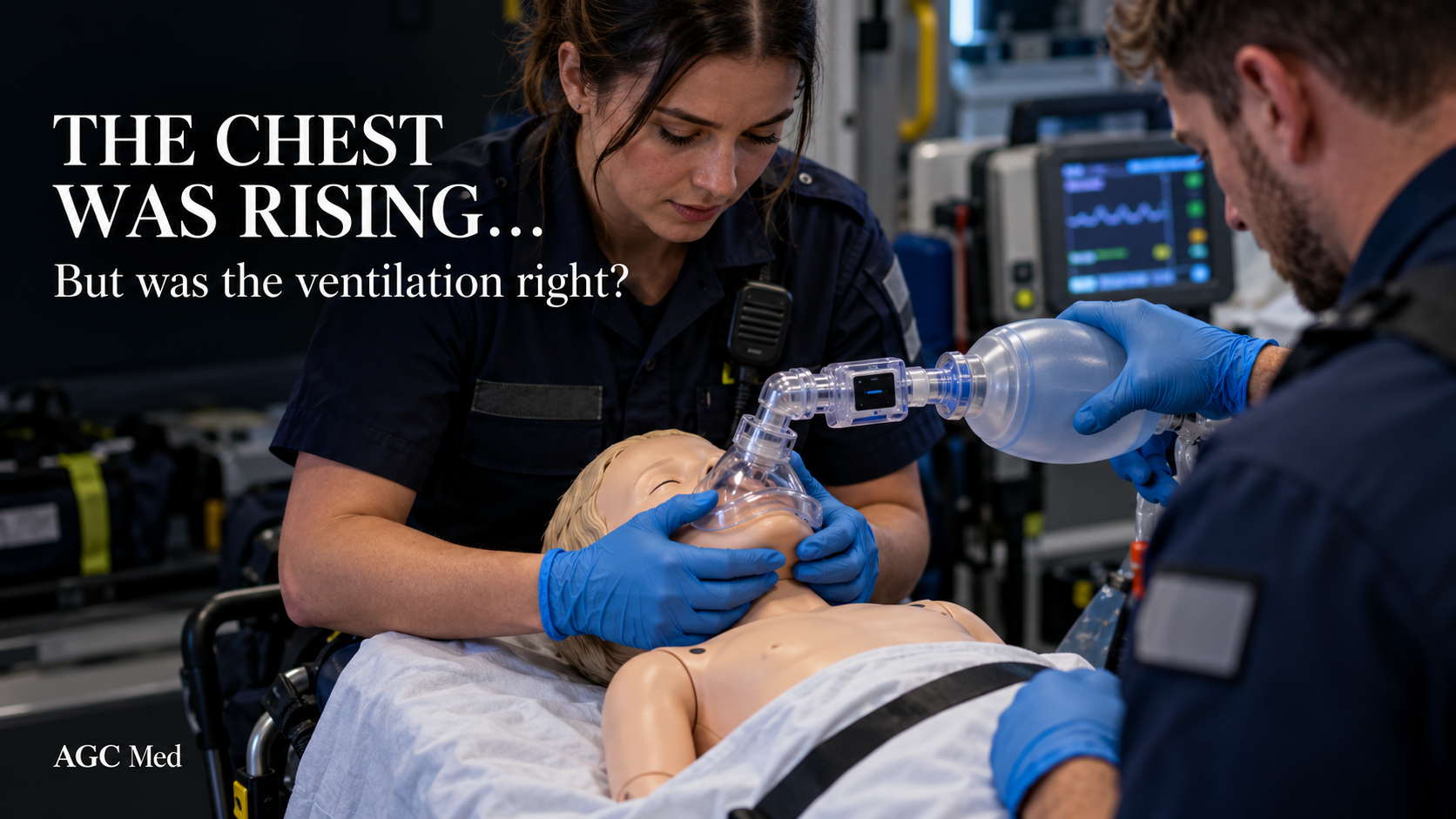
Picture a simulated call. A three-year-old child is unresponsive and not breathing adequately. A clinician opens the airway, applies the mask and squeezes the bag. The chest moves. Someone says, “We’re getting chest rise.” The team moves on.
It is a reassuring sentence. It should also leave us with a question: what, exactly, have we confirmed?
We have seen movement. We have not measured tidal volume, counted every breath or quantified the mask leak. A recent randomized simulation study gives us a reason to examine that gap more carefully.[1]
What changed when clinicians could see the measurements
Finney and colleagues studied 123 EMS clinicians from five agencies across three US metropolitan sites. Each performed two two-minute respiratory-arrest scenarios on a three-year-old manikin, with and without visible ventilation feedback in randomized order, separated by a ten-minute washout. The EOLifeX device recorded rate, tidal volume and mask leak.[1]
With feedback, breaths within the study’s recommended tidal-volume range increased from 16.2% to 87%. Rate adherence increased from 65% to 88.6%; breaths with mask leak below 30% increased from 80% to 88.4%.[1]
Those are breath-level performance measures, not percentages of children successfully resuscitated. The abstract does not show whether out-of-range volumes were predominantly too high or too low. Nor is the leak threshold a universal boundary between safe and unsafe care.[1]
The finding should make educators curious. If we watched the same performance without seeing the measurements, how often would we have passed it?
The study did not test the child in front of us
This was a short manikin study. It cannot establish clinical benefit, lasting skill retention or performance across different ages and illnesses. Our appraisal is limited to the publisher’s abstract; the full methods, funding and conflicts were unavailable for review.[1]
That boundary matters. A compelling number can travel further than the evidence behind it. “Feedback improved measured performance in this simulation” is defensible. “This device saves children’s lives” is a claim this study cannot support.
Chest movement is the start of an assessment
Respiratory deterioration is a major pathway to pediatric cardiac arrest, making prompt ventilation and oxygenation central to care.[2] The lesson is to assess the breath more completely while continuing timely support.
Ask what the chest movement tells you, then ask what information is still missing. In training, pair observation with measured rate, volume and leak. In practice, integrate available monitoring with airway assessment and the child’s response. A reassuring sign deserves context.
Avoid turning chest rise into a visual target that demands a larger and larger squeeze. Equally, avoid letting concern about over-ventilation distract from the need to provide effective breaths. The clinical task requires judgement about the whole patient.
Know which resuscitation situation you are treating
For infants and children with a pulse who need assisted breaths, the 2025 AHA/AAP guidance recommends 20–30 breaths per minute, approximately one every two to three seconds.[2] This is a contextual recommendation, not permission to apply one rate to every airway emergency.
During pediatric CPR with an advanced airway, the guidance also supports 20–30 breaths per minute while accounting for age and clinical characteristics; excessive ventilation can compromise haemodynamics.[3] CPR without an advanced airway requires its appropriate compression–ventilation sequence. Newborn resuscitation follows separate guidance.[2,3]
Before correcting a colleague’s rate, establish which situation the team is managing. Before teaching a numerical target, teach when it applies. Follow the relevant local protocol and reassess as the situation changes.
A monitoring number still needs an explanation
For a child with a perfusing rhythm and an endotracheal tube, exhaled CO₂ should confirm placement and should be monitored during transport; chest rise alone cannot reliably confirm tracheal placement.[3] At AGC Med, waveform capnography belongs in the assessment of every advanced airway.
During CPR, ETCO₂ reflects circulation as well as ventilation; reduced pulmonary blood flow can limit the signal.[3] A low value therefore demands interpretation, rather than an automatic instruction to squeeze faster. Ask about the airway, the circuit and the circulation together.
A feedback display also needs interpretation. Before adopting a device, establish its age and weight limits, what volume it reports, how it calculates leak, and what its readings mean in the intended circuit. These are practical questions for equipment evaluation, not outcomes demonstrated by this trial.
Teach the skill that the measurements expose
At AGC Med, we propose a simple training exercise. Ask a clinician to ventilate a pediatric manikin using the service’s own equipment, with measurements recorded but hidden. Before revealing them, ask the clinician to estimate the rate and describe the expected volume and seal.
Then review the recording together. Start with a neutral question: “What did you expect to see?” Identify one change to practice, repeat the attempt with feedback, and discuss what changed. Keep the debrief focused on actions the clinician can reproduce.
Later, repeat the assessment without visible feedback. That follow-up addresses a question the new study leaves unanswered: can the clinician reproduce the skill when the display is unavailable? Set the timing locally and record it as a training decision rather than a validated interval.
This proposal fits the wider 2025 AHA education guidance supporting booster training, spaced learning and deliberate practice with directed feedback.[4] The specific pediatric ventilation exercise described here is our educational application, not a tested package from that guideline.
Use the results to improve teaching and equipment preparation. If several clinicians struggle at the same point, examine the task as well as the individual. Does the equipment fit the scenario? Were targets explained clearly? Did the assessment reward speed while overlooking ventilation quality?
Make transport part of the rehearsal
For ambulance and flight teams, include a second assessment after a simulated move onto the stretcher. Change position, hand over the bag and repeat the checks. Ask the receiving clinician to explain how they know the ventilation remains effective.
This is a proposed training extension; the study did not test moving patients or aircraft operations. Its purpose is to make reassessment part of the team’s routine, so that “ventilating well before the move” does not become an assumption carried through the rest of the journey.
Give reassurance a stronger foundation
Return to that simulated child. The chest rises again. This time, the team can describe the rate, review the available measurements and explain what they are watching for. Their reassurance has a clearer basis.
The uncomfortable question is how often our assessment ends with “it looked right.” We owe learners an opportunity to discover the difference between what they intended to deliver and what they actually delivered.
The chest was rising. Let that observation begin the conversation about ventilation quality.
AGC Med — Where science meets humanity.
References
- Finney JD, Siegler J, Wang J, et al. Prehospital Pediatric Ventilation Quality Following Use of a Feedback Device: A Randomized Study. Pediatrics. Published online October 20, 2026:e2026077291. https://doi.org/10.1542/peds.2026-077291
- American Heart Association and American Academy of Pediatrics. Part 6: Pediatric Basic Life Support. 2025 Guidelines for Cardiopulmonary Resuscitation and Emergency Cardiovascular Care. https://cpr.heart.org/en/resuscitation-science/cpr-and-ecc-guidelines/pediatric-basic-life-support
- American Heart Association and American Academy of Pediatrics. Part 8: Pediatric Advanced Life Support. 2025 Guidelines for Cardiopulmonary Resuscitation and Emergency Cardiovascular Care. https://cpr.heart.org/en/resuscitation-science/cpr-and-ecc-guidelines/pediatric-advanced-life-support
- American Heart Association. Part 12: Resuscitation Education Science. 2025 Guidelines for Cardiopulmonary Resuscitation and Emergency Cardiovascular Care. https://cpr.heart.org/en/resuscitation-science/cpr-and-ecc-guidelines/resuscitation-education-science
Educational scope
For EMS, flight and critical care education. Apply local protocols, device instructions and patient-specific clinical judgement. This article does not address newborn resuscitation. Evidence checked on 23 October 2026.