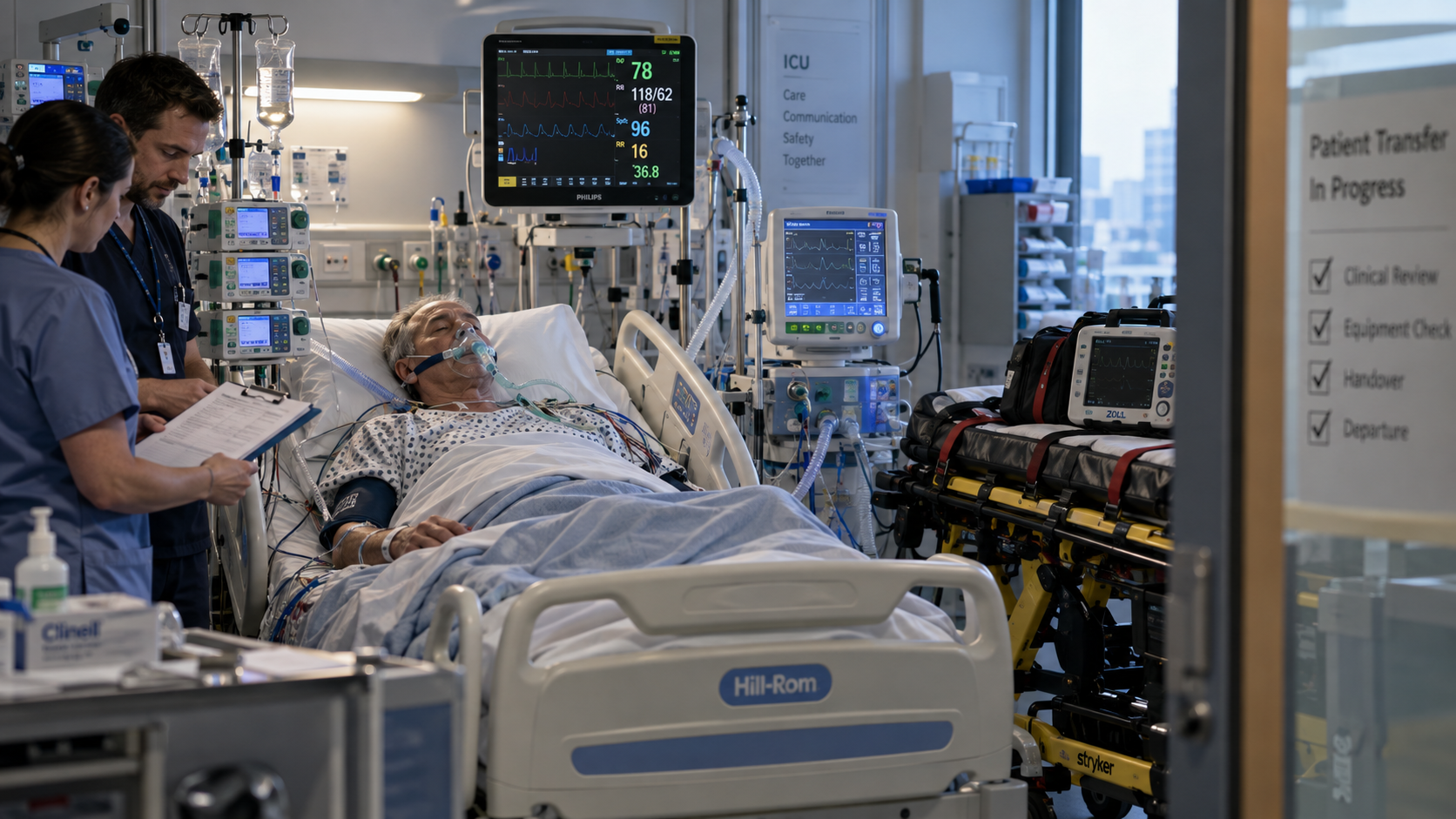
The patient is awake.
The blood pressure is acceptable.
The oxygen saturation looks good.
The monitor is quiet.
The sending team describes them as “stable for transfer.”
And yet, sometime later, in the back of an ambulance or aircraft, that same patient can be deteriorating rapidly.
Transporting critically ill patients carries inherent risk, and adverse events during transport may be related to the patient’s underlying physiology, treatment requirements, equipment, communication, or the transport process itself.[1,2]
That is one of the most important realities of critical care transport:
A stable patient at handover is not necessarily a stable patient for transport.
The difference matters because transport takes the patient away from the immediately available personnel, equipment and resources of a critical care environment and requires the transport team to maintain an equivalent level of monitoring and physiological support throughout the journey.[1,3]
For the transport clinician, the question should therefore never be simply:
“Is this patient stable?”
The better question is:
“What is keeping this patient stable, and will that stability survive the journey?”
Stability Is a Snapshot
We often describe patients using a collection of numbers.
Blood pressure 112/68.
Heart rate 96.
SpO₂ 96%.
Respiratory rate 20.
Perhaps the patient is talking comfortably and looks reasonably well.
Those observations are valuable, but they describe the patient at a specific moment under their current conditions. Assessment before transport should therefore include not only current physiological observations but also the patient’s treatment requirements, anticipated deterioration and the support that will need to continue during transport.[3,4]
Consider the hypotensive patient who has just received a fluid bolus.
Their blood pressure may have risen from 78 systolic to 105.
Technically, the number has improved.
But what happens when the effect of that intervention is insufficient to maintain perfusion?
Or consider the patient on non-invasive ventilation whose saturation is 97%.
That number may appear reassuring, but the oxygen saturation does not tell us how much respiratory support is required to achieve it, nor does it describe the patient’s work of breathing or likelihood of further deterioration.
The saturation is stable.
The patient may not be.
Numbers need context.
Ask What Is Holding the Patient Together
One of the most useful mental exercises before transport is to identify every intervention currently supporting the patient’s apparent stability.
Are they maintaining their blood pressure because of a norepinephrine infusion?
Is their oxygen saturation acceptable because they are receiving high-concentration supplemental oxygen?
Is their respiratory status being maintained by CPAP or BiPAP?
Have they just received repeated doses of analgesia or sedation?
Was a fluid bolus completed five minutes before the transport team arrived?
Has their ventricular rate recently been controlled pharmacologically?
Have they required repeated suctioning?
Are they becoming progressively more acidotic despite acceptable vital signs?
Transport guidance consistently emphasises assessment and optimisation before departure, continuation of necessary therapies during transport, and preparation for predictable clinical deterioration.[1,3-5]
Each of those details changes the meaning of the word stable.
The patient may not be stable independently.
They may be temporarily stabilised because multiple systems are actively supporting them.
That distinction should change how we prepare for transport.
Transport Removes Safety Margins
Inside an intensive care unit, emergency department or operating theatre, deterioration occurs in an environment specifically designed to provide rapid access to additional personnel, medications, airway equipment, ventilatory support, monitoring and resuscitation resources.
Transport changes that environment.
Once the doors close, the transport team must be capable of continuing the patient’s monitoring and treatment while also managing foreseeable emergencies with the personnel and equipment accompanying the patient.[1,3]
The monitor is your monitor.
The ventilator is your ventilator.
The infusions you brought are the infusions available.
The airway equipment you packed is the airway equipment you will use.
And deterioration may occur while travelling at highway speed, inside an aircraft, during loading, inside an elevator, or halfway between two hospitals.
Adverse events during transport are not theoretical. A 2022 systematic review and meta-analysis examining more than 12,000 intrahospital transports reported an overall pooled adverse-event frequency of 26.2%, although event definitions varied considerably between studies and serious events were much less frequent.[2]
Interhospital transport studies similarly identify patient-related complications as well as important logistical and equipment-related problems during critical care transfer.[6]
That is why transport medicine requires a slightly different mindset.
The question is not simply whether a problem exists now.
It is whether a predictable problem could develop before you have the ability to replace whatever fails.
The Dangerous Patient May Look Fine
Some high-risk transport patients can initially appear relatively well.
The compensated shock patient
Blood pressure alone should never be interpreted in isolation from the patient’s overall perfusion, trajectory and treatment requirements.
A patient requiring increasing cardiovascular support to maintain an acceptable pressure is clinically different from a patient maintaining the same pressure without intervention.
A MAP of 70 mmHg may therefore mean very different things depending on what is required to produce it.
The respiratory patient who is tiring
A patient with significant respiratory distress may still maintain an acceptable oxygen saturation, particularly while receiving supplemental oxygen or non-invasive respiratory support.
But oxygen saturation alone does not describe the patient’s complete respiratory condition.
The patient sitting upright, using accessory muscles, breathing 35 times per minute and becoming progressively fatigued requires assessment that goes far beyond the SpO₂ displayed on the monitor.
The important transport question becomes:
Can this patient maintain this level of respiratory effort for the duration of the journey?
Patients requiring mechanical or non-invasive respiratory support should be assessed and stabilised before transport, and the transport system must be capable of continuing the level of ventilatory support required by the patient’s clinical condition.[3,5]
The patient on escalating vasopressor support
A blood pressure or MAP within an apparently acceptable range can conceal the amount of pharmacological support required to maintain it.
If norepinephrine requirements have progressively increased, the trend matters.
A stable number produced by escalating support should not automatically be interpreted as stable physiology.
The difficult airway waiting to happen
The patient may be oxygenating adequately now.
But consider what happens if they deteriorate and lose airway patency or ventilatory capacity.
Could you ventilate them?
Could you intubate them?
Would airway swelling, anatomy, blood, secretions or positioning make rescue difficult?
Transport recommendations therefore call for appropriate airway equipment and personnel capable of managing airway emergencies when transporting critically ill patients.[1,3]
Transport planning must consider the airway the patient might need, not simply the airway they have at handover.
Trend Matters More Than a Single Number
One of the most valuable questions a transport clinician can ask during handover is:
“What has changed over the last few hours?”
That question provides context to the patient’s current physiology and helps identify whether treatment requirements are increasing or decreasing before departure. Pre-transport assessment should consider the patient’s current condition, response to treatment and anticipated needs during transfer.[3,4]
A blood pressure of 104 systolic means something very different if it has been:
118 → 112 → 108 → 104
than if it has been:
82 → 90 → 98 → 104.
The number is identical.
The trajectory is not.
The same principle applies to oxygen requirements, ventilatory support, urine output, lactate, mental status, vasopressor requirements, haemoglobin, heart rate and respiratory effort.
Transport medicine should therefore be trend-focused rather than snapshot-focused.
Predict the Next Problem
Before moving a critically ill patient, stop and ask:
What is the most likely thing to go wrong during this transport?
Then ask:
What is the most dangerous thing that could reasonably go wrong?
They are not always the same.
For a septic patient receiving norepinephrine, the likely problem may be worsening hypotension.
For a patient with severe respiratory failure on non-invasive ventilation, the dangerous problem may be progression to respiratory failure requiring invasive airway management.
For a gastrointestinal bleed, it may be haemodynamic deterioration.
For a patient with an acute coronary syndrome, it may be a malignant dysrhythmia.
For a ventilated patient with worsening respiratory mechanics, it may be sudden deterioration requiring immediate troubleshooting and intervention.
Pre-transport planning is specifically intended to anticipate these problems and ensure the appropriate personnel, monitoring, medications, airway equipment, oxygen, ventilatory support and resuscitation equipment are immediately available.[1,3,4]
Once the likely failure point has been identified, preparation becomes much easier.
Do we need another vasopressor prepared?
Should blood products accompany the patient when clinically indicated?
Do we need additional oxygen?
Is the airway equipment immediately accessible rather than buried in a bag?
Are emergency medications available?
Can the transport ventilator reproduce the support the patient currently requires?
Do we have adequate battery capacity?
Do we have enough oxygen and medication to tolerate an unexpected delay?
Guidance specifically recommends checking oxygen supplies, battery-operated equipment, monitoring systems and emergency equipment before departure.[3]
These are not simply equipment questions.
They are clinical planning questions.
Resuscitate Before You Mobilise
There is sometimes pressure to move quickly because a bed is available, an aircraft is waiting, an ambulance has arrived or the receiving team is expecting the patient.
But movement should not become the priority simply because transportation has been arranged.
There is an important difference between:
“This patient needs urgent definitive care.”
and:
“This patient needs to leave immediately regardless of their current physiology.”
Critical care transport guidance consistently recommends stabilizing and optimizing the patient as far as reasonably possible before departure.[1,3,5]
In a prospective study of 100 critically ill patients being prepared for inter-hospital transfer, specialist transport teams frequently increased or instituted monitoring and therapies before departure, including oxygen, intravenous fluids, ventilation, PEEP and inotropic support.[7]
That finding is important.
Preparing a patient for transport may require more support, not less.
When possible, correct reversible instability before departure.
Secure the airway when clinically indicated.
Optimize ventilation and oxygenation.
Address circulatory instability.
Treat dangerous dysrhythmias.
Establish reliable vascular access.
Ensure appropriate analgesia and sedation.
Ensure vasoactive infusions are running reliably.
Resolve equipment incompatibilities before the patient leaves the bed.
The aim is not to make every critically ill patient physiologically normal before transport.
The aim is to avoid beginning the journey with a foreseeable problem that could have been managed more safely before departure.
The First Few Minutes of Transport Matter
Moving from the hospital bed to the transport system involves multiple changes.
The patient moves onto another stretcher.
Infusion lines are repositioned.
Ventilator circuits move.
Oxygen sources may change.
Monitoring may transition to portable equipment.
The patient’s position may change.
Transport equipment replaces bedside equipment.
Every one of those transitions creates an opportunity for interruption, disconnection, equipment failure or physiological change, which is why structured preparation and equipment checks are repeatedly emphasized in transport guidance.[1,3]
After transferring the patient onto the transport stretcher and connecting all transport equipment, reassess.
Do not assume that because the patient tolerated the hospital bed, they will tolerate the transport configuration.
Look again.
Blood pressure.
Heart rate and rhythm.
Waveforms.
Ventilation.
SpO₂.
ETCO₂ when indicated.
Infusions.
Mental status.
Respiratory effort.
International guidance recommends continued physiological monitoring appropriate to the patient’s condition throughout transport, with monitoring and treatment standards designed to maintain continuity of critical care.[1,3]
The transition from hospital equipment to transport equipment is therefore part of the clinical assessment.
“Stable for Transfer” Is Not a Diagnosis
Perhaps the most important cultural change is to stop treating the phrase “stable for transfer” as though it were an objective physiological diagnosis.
It is not.
A critically ill patient can have acceptable observations while receiving substantial organ support.
They can be temporarily stabilized following an intervention.
They can be maintaining their physiology only because of vasoactive, ventilatory or other ongoing treatment.
And their clinical trajectory may be improving or deteriorating despite an apparently acceptable set of current vital signs.
Transport safety depends upon careful assessment, stabilization, anticipation of complications, appropriate personnel, appropriate equipment, continued monitoring and the ability to maintain treatment throughout the journey.[1,3,4]
The transport clinician therefore needs to look beyond the label.
Ask:
What has happened?
What has changed?
What is supporting the patient right now?
What physiological reserve remains?
What is most likely to fail next?
And am I prepared to manage that failure when the hospital doors disappear behind us?
That is the difference between simply moving a patient and practicing critical care transport medicine.
Because the safest transport does not begin when the ambulance starts moving.
It begins at the bedside, before the patient ever leaves the room.
A stable handover can hide an unstable transport.
Our job is to recognize the difference.
References
1. Warren J, Fromm RE Jr, Orr RA, Rotello LC, Horst HM; American College of Critical Care Medicine. Guidelines for the inter- and intrahospital transport of critically ill patients. Critical Care Medicine. 2004;32(1):256–262. doi:10.1097/01.CCM.0000104917.39204.0A.
2. Murata M, Nakagawa N, Kawasaki T, et al. Adverse events during intrahospital transport of critically ill patients: A systematic review and meta-analysis. American Journal of Emergency Medicine. 2022;52:13–19. doi:10.1016/j.ajem.2021.11.021.
3. Zirpe KG, Tiwari AM, Kulkarni AP, et al. Position Statement of ISCCM on Intrahospital Transport of Critically Ill Patients. Indian Journal of Critical Care Medicine. 2025;29(4):291–300. doi:10.5005/jp-journals-10071-24939.
4. Kiss T, Bölke A, Spieth PM. Interhospital transfer of critically ill patients. Minerva Anestesiologica. 2017;83(10):1101–1108. doi:10.23736/S0375-9393.17.11857-2.
5. Stevenson VW, Haas CF, Wahl WL. Intrahospital transport of the adult mechanically ventilated patient. Respiratory Care Clinics of North America. 2002;8(1):1–35. doi:10.1016/S1078-5337(02)00014-X.
6. Denton G, Green L, Palmer M, et al. Evaluation of the safety of inter-hospital transfers of critically ill patients led by advanced critical care practitioners. British Journal of Nursing. 2021;30(8):470–477. doi:10.12968/bjon.2021.30.8.470.
7. Runcie CJ, Reeve WR, Wallace PG. Preparation of the critically ill for interhospital transfer. Anaesthesia. 1992;47(4):327–331. doi:10.1111/j.1365-2044.1992.tb02175.x.