
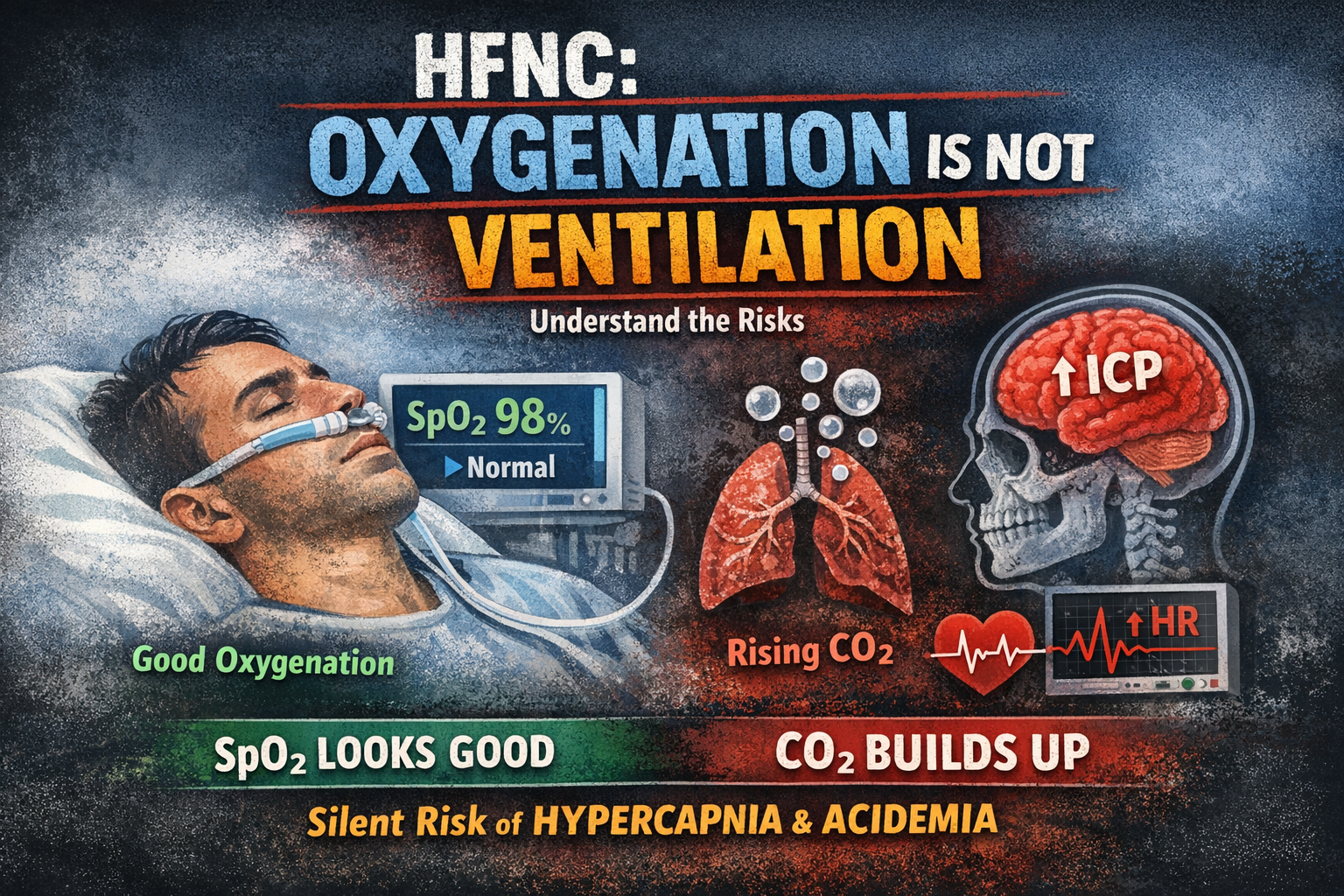
There is a moment most of us recognise, although we rarely say it out loud.
You place a patient on high-flow nasal cannula.
The respiratory rate slows.
The anxiety softens.
The oxygen saturation climbs into numbers that make everyone in the room relax a little.
The monitor looks calmer.
And in that quiet relief… something subtle happens.
We stop asking the harder question.
Is this patient actually ventilating?
Because high-flow nasal cannula (HFNC) has quietly become one of the most valuable tools in modern respiratory care. It sits perfectly in that clinical space between low-flow oxygen and positive pressure ventilation. It reduces work of breathing. It improves oxygenation. It improves tolerance compared with masks. It buys time.
But time is only helpful if you understand what you are buying.
HFNC does many things well.
Ventilation is not reliably one of them.
Why HFNC Feels Like It Works So Well
HFNC delivers heated, humidified gas at high flow rates — often approaching 60 litres per minute in adults depending on the system used. This allows clinicians to deliver predictable oxygen concentrations while meeting the patient’s inspiratory demand more effectively than conventional oxygen devices.¹
And physiologically, HFNC is elegant.
High flows wash out carbon dioxide within the nasopharyngeal dead space, improving ventilatory efficiency in patients who are still breathing spontaneously.² The flow itself can generate a small amount of positive airway pressure, particularly when the patient keeps their mouth closed, which can assist alveolar recruitment.³ Humidification improves secretion clearance, comfort, and long-term tolerance.⁴
These mechanisms explain why patients often look and feel better shortly after HFNC is applied. Respiratory rates fall. Distress decreases. Communication improves. Families feel reassured. Clinicians feel reassured.
But physiologic comfort and physiologic stability are not always the same thing.
The Problem We Don’t Talk About Enough: Oxygenation Is Not Ventilation
HFNC is fundamentally an oxygenation therapy.
It can support breathing.
It can reduce respiratory workload.
It can delay respiratory collapse.
What it cannot reliably do is replace ventilation when ventilation is failing.
In apnoea, HFNC can prolong oxygenation through apnoeic oxygenation techniques. However, carbon dioxide continues to accumulate, and progressive acidosis develops despite reassuring oxygen saturation readings.⁵
Even in spontaneously breathing patients, HFNC is not designed to correct acute ventilatory failure where carbon dioxide clearance is the primary problem. Current respiratory and intensive care guidelines continue to recommend non-invasive ventilation as first-line therapy in hypercapnic respiratory failure when appropriate.⁶
And this is where HFNC becomes clinically dangerous — not because it fails, but because it succeeds in a way that can hide deterioration.
The Patient Who Looks Better… Until They Don’t
Most HFNC failures do not look dramatic in the beginning.
They look comfortable.
The patient remains tachypnoeic but less anxious.
The saturation is excellent, often requiring very high FiO₂.
The work of breathing is still present but slightly less obvious.
The room relaxes.
Meanwhile, ventilation may be quietly worsening.
Carbon dioxide rises gradually.
Respiratory muscles fatigue slowly.
Mental status begins to drift.
HFNC can create a physiological environment where oxygenation remains preserved while ventilation collapses underneath it. This mismatch has been repeatedly demonstrated in studies examining high-flow oxygen use during apnoeic oxygenation strategies.⁵
And because oxygen saturation is one of the most psychologically reassuring vital signs in medicine, clinicians can develop an unintentional fixation on it.
The monitor shows green numbers.
And green numbers feel safe.
Where HFNC Truly Shines
There is strong, high-quality evidence supporting HFNC in acute hypoxaemic respiratory failure, particularly in patients without primary hypercapnia. The FLORALI trial demonstrated improved clinical outcomes with HFNC compared with standard oxygen therapy in selected hypoxaemic respiratory failure populations.⁷
HFNC has also become well established as supportive therapy following extubation in selected patient groups, where comfort, secretion management, and sustained oxygen delivery are critical.⁸
It is particularly valuable in patients who cannot tolerate tight-fitting masks, who require prolonged oxygen therapy, or who benefit from remaining awake, communicative, and able to maintain oral intake.
In these patients, HFNC is not simply a respiratory device.
It becomes a quality-of-care intervention.
Where HFNC Can Quietly Lead Us in the Wrong Direction
HFNC is frequently applied in scenarios where the underlying pathology demands ventilation rather than oxygenation.
Hypercapnic COPD exacerbations remain one of the most common examples. While HFNC may reduce work of breathing and improve comfort, it does not consistently correct carbon dioxide retention when acidosis is present.⁶
Similarly, patients with acute cardiogenic pulmonary oedema have strong evidence supporting early non-invasive positive pressure ventilation. HFNC may improve oxygenation, but it does not provide the same degree of alveolar recruitment or afterload reduction achieved with positive pressure therapy.⁹
In these situations, HFNC can unintentionally delay definitive therapy.
And delay is often the true complication.
The Cognitive Biases That Make HFNC Dangerous
The risk surrounding HFNC is rarely technical. It is cognitive.
Reassurance Bias
Improved oxygen saturation creates a false perception of global stability. Oxygenation becomes a surrogate marker for respiratory success, even when ventilation remains inadequate.
Comfort Bias
When patients appear calmer and more cooperative, clinicians often feel treatment is working. Comfort becomes mistaken for physiologic improvement.
Therapeutic Momentum
Once HFNC is initiated and appears beneficial, clinicians may hesitate to escalate therapy despite signs of deterioration, particularly when escalation involves intubation.
Monitoring Bias
Respiratory rate and work of breathing remain some of the most sensitive indicators of deterioration, yet they are frequently overshadowed by continuous oxygen saturation monitoring.
These biases are rarely conscious.
They are human.
And that is precisely why they are dangerous.
Recognising HFNC Failure Early
HFNC failure usually declares itself clinically long before oxygen saturation falls.
The most reliable early indicators remain:
-
Persistent or rising respiratory rate
-
Increasing accessory muscle use or inability to speak comfortably
-
Progressive fatigue or diaphoresis
-
Worsening mental status
-
Hemodynamic instability
-
Rising carbon dioxide or acidosis when measured
The ROX index — combining oxygenation and respiratory rate — has been validated as a predictor of HFNC success and failure in hypoxaemic respiratory failure. A ROX index above 4.88 at twelve hours has been associated with lower intubation risk in pneumonia-related respiratory failure.¹⁰
But indices should never replace clinical judgement.
They should only sharpen it.
Correcting HFNC Problems: The Practical Approach
The first step is always to optimise the device itself.
Flow rates should be increased to meet inspiratory demand, as increasing flow often reduces work of breathing more effectively than increasing FiO₂ alone.³ Cannula sizing must allow adequate exhalation. Patient positioning, secretion clearance, and nasal patency remain essential but frequently overlooked details.
The second step is addressing the underlying pathology. HFNC supports physiology but does not correct disease processes. Bronchospasm still requires bronchodilators. Pulmonary oedema still requires preload and afterload reduction. Infection still requires antimicrobial therapy.
The final step — and often the hardest — is recognising when HFNC has reached its limit.
When ventilation is failing, escalation to non-invasive ventilation or intubation should occur early rather than as rescue therapy.
Delayed intubation following HFNC failure has been associated with worse outcomes in several observational studies examining acute respiratory failure progression.¹¹
Time can be a therapeutic tool.
But it can also be a debt that must eventually be paid.
The Quiet Lesson HFNC Teaches Us
HFNC is not a dangerous therapy.
It is an extraordinarily effective one.
The danger lies in how easily it makes respiratory distress look controlled.
Medicine has always carried a fascination with oxygen. We chase saturation numbers aggressively. We celebrate rapid improvements in SpO₂. We teach oxygenation early and often.
Ventilation, by comparison, is quieter.
Harder to see.
Harder to measure without deliberate assessment.
And yet ventilation is frequently the determinant of survival in respiratory failure.
HFNC reminds us of something uncomfortable but true.
Patients do not die from low oxygen saturation displayed on a monitor.
They die from failing physiology that sometimes looks deceptively stable while it collapses underneath.
HFNC buys time.
It improves comfort.
It supports oxygenation beautifully.
But it does not absolve clinicians from the responsibility of asking the most important respiratory question in critical care:
Is this patient still moving enough air to survive what comes next?
Because sometimes the most dangerous number in medicine is the one that looks perfect.
References
-
Dysart K, Miller TL, Wolfson MR, Shaffer TH. Research in high-flow therapy: mechanisms of action. Respiratory Medicine. 2009;103(10):1400-1405. DOI: 10.1016/j.rmed.2009.04.007
-
Onodera Y, Akimoto R, Suzuki H, et al. The effect of high-flow nasal cannula therapy on anatomical dead space washout. Korean Journal of Anesthesiology. 2017;70(1):105-111. DOI: 10.4097/kjae.2017.70.1.105
-
Parke RL, McGuinness SP, Eccleston ML. A preliminary randomized controlled trial of nasal high-flow oxygen in respiratory failure. Respiratory Care. 2011;56(3):265-270. DOI: 10.4187/respcare.00801
-
Ritchie JE, Williams AB, Gerard C, Hockey H. Evaluation of a humidified nasal high-flow oxygen system. Anaesthesia and Intensive Care. 2011;39(6):1103-1110. DOI: 10.1177/0310057X1103900622
-
Patel A, Nouraei SAR. Transnasal humidified rapid-insufflation ventilatory exchange (THRIVE). Anaesthesia. 2015;70(3):323-329. DOI: 10.1111/anae.12923
-
Rochwerg B, Brochard L, Elliott MW, et al. Official ERS/ATS clinical practice guidelines: non-invasive ventilation for acute respiratory failure. European Respiratory Journal. 2017;50(2):1602426. DOI: 10.1183/13993003.02426-2016
-
Frat JP, Thille AW, Mercat A, et al. High-flow oxygen through nasal cannula in acute hypoxemic respiratory failure. New England Journal of Medicine. 2015;372(23):2185-2196. DOI: 10.1056/NEJMoa1503326
-
Oczkowski S, Ergan B, Bos L, et al. ERS clinical practice guidelines: high-flow nasal cannula in acute respiratory failure. European Respiratory Journal. 2022;59(4):2101574. DOI: 10.1183/13993003.01574-2021
-
Masip J, Roque M, Sánchez B, Fernández R, Subirana M, Expósito JA. Noninvasive ventilation in acute cardiogenic pulmonary edema: systematic review and meta-analysis. JAMA. 2005;294(24):3124-3130. DOI: 10.1001/jama.294.24.3124
-
Roca O, Caralt B, Messika J, et al. An index combining respiratory rate and oxygenation to predict outcome of nasal high-flow therapy. American Journal of Respiratory and Critical Care Medicine. 2019;199(11):1368-1376. DOI: 10.1164/rccm.201803-0589OC
-
Kang BJ, Koh Y, Lim CM, et al. Failure of high-flow nasal cannula therapy may delay intubation and increase mortality. Intensive Care Medicine. 2015;41(4):623-632. DOI: 10.1007/s00134-015-3693-5
Step 4: If apnoea is part of the plan, name the risk out loud
If HFNC is being used during apnoea (e.g., procedural airway management), assume:
-
CO₂ will rise
-
pH will fall
-
Hemodynamic and neurologic consequences can follow in susceptible patients (e.g., raised ICP risk, pulmonary hypertension physiology)
That means strict time awareness, backup ventilation plans, and monitoring strategies where feasible. ScienceDirect+1
Practical “AGC Med” takeaways
-
HFNC is a powerful oxygenation + comfort platform for hypoxemic respiratory failure. New England Journal of Medicine+1
-
HFNC is not a ventilator—and in apnoea it will not prevent progressive hypercapnia. ScienceDirect+2PubMed+2
-
Your job is to prevent the two classic HFNC harms:
-
Delayed escalation (patient looks “fine” on SpO₂ but is working harder)
-
CO₂ blindness (especially in fatigue/hypoventilation or apnoeic strategies)
-
References
-
Wen GA. High-flow nasal oxygenation, not ventilation: time to stop holding our breath. British Journal of Anaesthesia. 2025 (Articles in Press). ScienceDirect
-
Frat J-P, Thille AW, Mercat A, et al. High-flow oxygen through nasal cannula in acute hypoxemic respiratory failure. N Engl J Med. 2015;372(23):2185–2196. New England Journal of Medicine+1
-
Oczkowski S, Ergan B, Bos L, et al. ERS clinical practice guidelines: high-flow nasal cannula in acute respiratory failure. Eur Respir J. 2022;59:2101574. ERS Publications+1
-
Roca O, Riera J, Torres F, Masclans JR. Predicting success of high-flow nasal cannula in pneumonia patients with hypoxemic respiratory failure: the utility of the ROX index. J Crit Care. 2016;35:200–205. PubMed
-
Roca O, Messika J, Caralt B, et al. An index combining respiratory rate and oxygenation to predict outcome of nasal high-flow therapy. Am J Respir Crit Care Med. 2019. PubMed+1
-
Lyons C, McElwain J, Young O, Callaghan M. The effect of high-flow nasal oxygen flow rate on gas exchange in apnoeic patients: a randomised controlled trial. Anaesthesia. 2024;79(6):576–582. PubMed
-
Sud A, Patel A. THRIVE: five years on and into the COVID-19 era (review of apnoeic HFNO/CO₂ accumulation rates). Anaesthesia/Review (PMC). 2021. PMC
-
Booth AWG, et al. The effect of high-flow nasal oxygen on carbon dioxide accumulation during apnoea (review/physiology). [PubMed record]. PubMed
-
Séverin A, et al. Use of high-flow nasal cannula in out-of-hospital setting (ALS ambulance feasibility). [PMC]. 2021. PMC
-
Kedzierewicz R, et al. Logistical challenge with prehospital use of high-flow nasal oxygen (case-based feasibility concerns). [PMC]. 2021. PMC
-
McCoy AM, et al. Prehospital noninvasive ventilation: NAEMSP position statement (notes evolving devices including HFNC, less proven prehospital). Prehosp Emerg Care. 2022. Taylor & Francis Online
-
Marjanovic N, et al. High-flow nasal cannula oxygen versus noninvasive ventilation in acute heart failure–related respiratory failure (ED study). [PubMed]. 2024. PubMed